
Alessandro Michele closed his first Valentino show in Rome with a full-length red dress whose V-shaped cutout at the back ran from shoulders to sacrum. It was both a salute to the late founder and an exhalation after a complex exercise.
Speaking afterwards, Michele said: “I let the color go, because it has a presence. Red is very difficult to handle… Here it is a sign that gives you chills when you see it.”

Now nearly two years into his time at the house, Michele said he sees himself as an “interference” in the aesthetic edifice its founder constructed. “Valentino made those lessons perfect, and I am always a little crooked,” he said. This is why Interference was the name of the collection, and tension—whether associative, visual, or emotional—was what Michele wanted to generate.
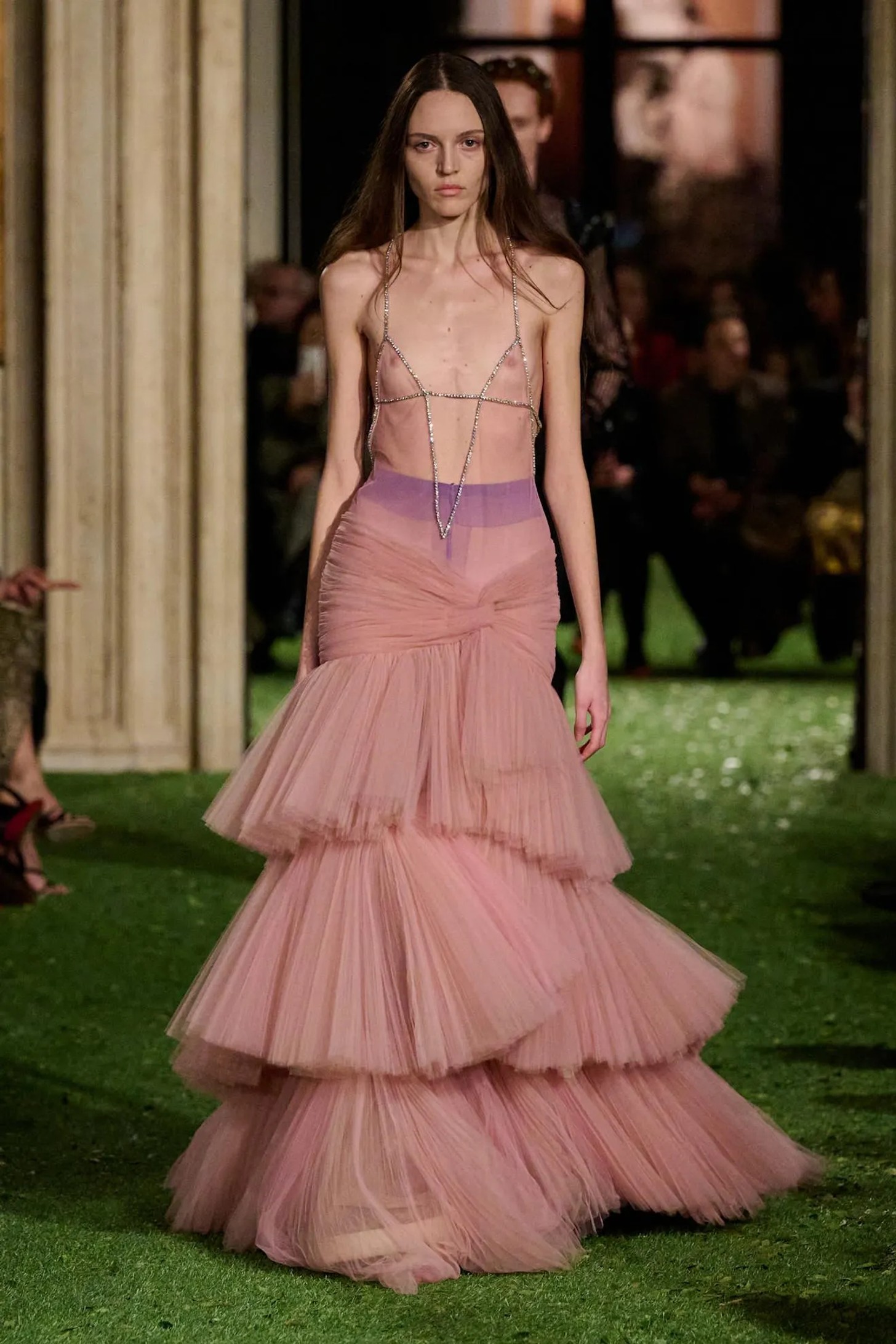
The urgent frequency of his eclectic tastes signaled far more strongly in the looks that came before that last one. A bolstered, rounded shoulderline emanated high-1980s excess: from it Michele hung multiple versions of his glitched Valentino woman, sometimes accented with butterfly-shaped hardware that suggested the metamorphosis he was exploring.
Bow-tied belts cinched full-length furs or cropped wrap leather coats with wide-action shoulders. Satin sash belts cut across color-block pleated tunics and over lace-hemmed jeans with Rockstud pumps. Whipped twists of double-faced taffeta were slung in swirls from the hip beneath more deep-V cutouts, this time at the front and framed in lace. The graphic zigzag of black-edged pink and ivory in a sequined full-sleeve jacket illustrated the ka-pow Michele was punching for.
The menswear was less mixed, but no less subject to tension. From the front the double-breasted gray jacket in look five appeared almost banal, but at the back a harmony-busting vortex of drapery whirled like water pushed through a propeller. “I am always standing with two feet in two different places,” Michele said. “You must hold on, you must let go.”
Full-legged trousers were shaped by purposefully mish-mashed pleating that might have been pressed either through design or dereliction; that ambiguity seemed the point. There was an abundance of almost ecclesiastical drape and fold that echoed the raiments painted by Cortona on the ceiling above us in Palazzo Barberini.
In one of his notes (Michele luxuriates in rhetorical material as much as he does fabric) it was asserted that the collection “celebrates order while simultaneously revealing its own structural vulnerability”: the classic rise and fall. Surrounded by so much artistic and architectural history, and charged with carrying the torch for such a canonical emperor in the city’s fashion lore, Michele is teasing at glitches and running interference in order to place Valentino as just much in the now as it will forever be in the then.



GLAMOUR Recommends
Jazz it up: Fashion tips for the Cape Town International Jazz Festival
Paris Fashion Week: Balmain's F/W26 Collection Signals A New Era Under Antonin Tron"
A Joyful Celebration of Dior: Jonathan Anderson's Latest Collection at Paris Fashion Week
Celebrating black excellence at the 57th NAACP Image awards
Gucci presents their Fall/Winter 26 collection
Milan Fashion Week: We spotlight our top street style looks
GLAMOUR's fashion director's personal reflection on the Met Gala's dress code


