
For nearly a decade, Bushra Razack has been at the forefront of community-led innovation and social impact in South Africa, helping to transform Philippi Village into a nationally recognised hub for entrepreneurship, opportunity and possibility. A respected leader, strategist and change-maker, Razack has built her career on a simple but powerful belief: that the people closest to a problem are often closest to the solution.
Recently representing South Africa at the Estée Lauder Vital Voices Global Summit in New York, Bushra found herself among some of the world's most influential women leaders. Yet rather than returning home inspired by status or prestige, she came back with a renewed commitment to trust, storytelling and the transformative power of community. As she embarks on a new chapter, including the launch of an impact fund rooted in partnership and purpose, she reflects on leadership, identity, representation and what it truly means to be a woman in charge.

Here, she shares the lessons she's learned from building alongside communities, the challenge of letting go of a role that shaped her for nearly a decade, and why agency, not control, is the real measure of success.
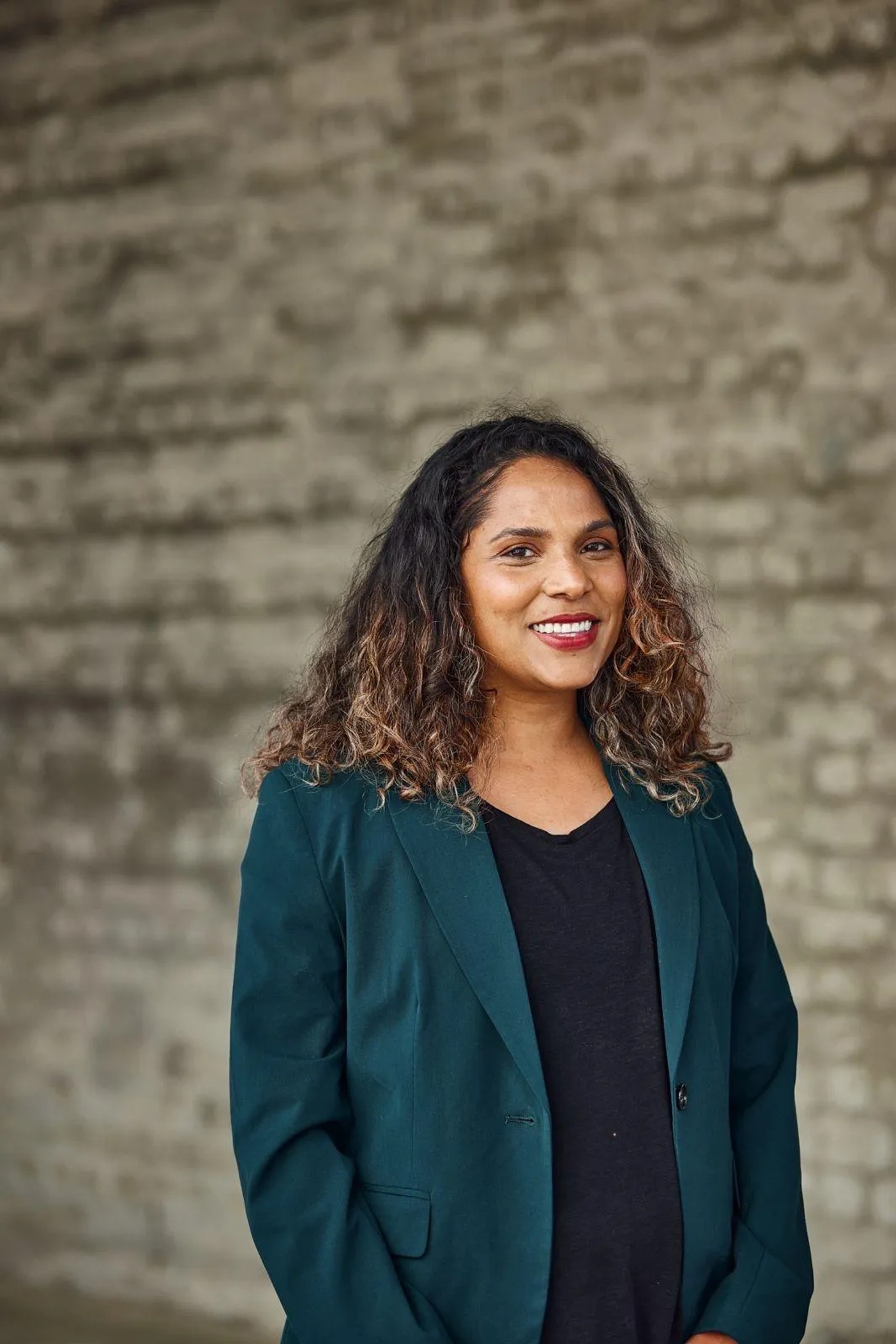
GLAMOUR: You attended the Estée Lauder Vital Voices Global Summit in New York. What was the most meaningful lesson or moment you brought home with you?
Bushra: The Estée Lauder Vital Voices Global Summit was one of those rare experiences that stays with you long after you've left the room. I flew home to South Africa carrying something I couldn't quite put into words at first. It took me a few days to realise what it was: possibility. The felt, embodied sense of what becomes available when women with power, purpose and perspective are brought together without hierarchy or competition.
The energy in that room was unlike anything I have experienced. Women from every corner of the world and yet an immediate, almost instinctive recognition of one another. There is something profound about representing South Africa in a space like that. You arrive carrying your country with you, and you leave with a renewed sense of responsibility to it.
But if I had to name the single most meaningful moment, it was a session on storytelling as a tool for innovation and systems change. And what struck me wasn't the concept…I have long believed in the power of stories.
Stories are not soft. They are infrastructure. They carry what data alone cannot: context, trust, lived reality, the human texture of complex problems. And the most sophisticated thing any leader can do is create the conditions for those stories to enter the room. When people don't feel safe enough to speak honestly, nothing that follows will be as good as it could be. The best strategies, the most innovative solutions, the deepest partnerships… all of it depends on whether truth can move freely between people.
That is why the stories Glamour tells matter more than people perhaps realise. The narratives placed in front of women, about who they are, what they are capable of, what they deserve, shape how they see themselves, how they celebrate themselves, and how they move through the world. That is not just media. That is a form of power. And in the right hands, it is a form of liberation.
GLAMOUR: You found yourself in the company of global leaders such as Hillary Clinton and Diane von Furstenberg. How did that experience shape your understanding of your own leadership journey?
What struck me most about being in that room was not the stature of the women in it. It was that they were still learning, still questioning, still evolving. There was no performance of arrival, no projection of having it all figured out. Watching women of that calibre remain curious and open dismantled the idea that leadership is a destination. It is not somewhere you get to. It is something you keep choosing.
Being in those spaces also clarified something equally important: not just the kind of leader I aspire to be, but the kind I don't. Exposure to greatness is a gift, but it is most useful when it helps you understand your own distinct voice rather than simply admire someone else's.
I left with a deeper sense of the leader I am becoming. It is one rooted in the specific context of this continent, this community, this country. Global in perspective, but unambiguously South African in purpose. That, I think, is what the best rooms do. They don't make you want to become someone else. They make you more committed to becoming yourself.
GLAMOUR: You've said you didn't traditionally see yourself as part of the "glamour" world. What shifted in your thinking during this experience?
Bushra: I'll be honest, I have never been what anyone would describe as conventionally glamorous. Sweatpants and a hoodie are, on most days, my idea of a complete outfit. The worlds I have moved in are not worlds that typically intersect with fashion spreads and highlight reels. Somewhere along the way, I internalised the idea that glamour and purpose were separate lanes. I was wrong. What I witnessed at the summit is that some of the most glamorous women in the room were the ones most deeply rooted in their work, their communities and their convictions. That confidence, grounded, purposeful, unshakeable — is one of the most powerful things I have ever seen.
I came away understanding that glamour, at its best, is not about what you wear or how you look. It is about how fully you inhabit yourself. It is the energy of a woman who knows who she is, what she stands for and why it matters. We need broader definitions of what success, influence and beauty look like. Because glamour that only celebrates one kind of woman, one kind of achievement, one kind of aesthetic — is glamour that leaves too many extraordinary people out. And that is a loss for all of us.
GLAMOUR: Much of your career has been rooted in community-building and social impact. How has that shaped the kind of leader you are today?
Bushra: Community work teaches you things that no leadership programme can simulate. And the most important of those lessons is this: proximity changes everything.
When you spend years working alongside communities rather than on their behalf, you develop a fundamentally different relationship with power, with knowledge and with what it means to lead. The people closest to a problem almost always understand it better than those observing it from a distance. The most innovative solutions rarely come from the top down, they emerge from the ground up. That has shaped me into a leader who leads with listening. Not performative listening, but active, genuinely curious listening. The kind that assumes the person in front of you knows something you don't. It has also taught me that trust is the most important currency in any room. In communities, you cannot fake it. You earn it slowly, through consistency, through presence, through doing what you said you would do. Those instincts: proximity, listening and trust, are the ones I carry into every space I occupy. Get close. Listen first. Build trust before you build anything else.
GLAMOUR: You recently stepped away from leading Philippi Village after nearly a decade. What has this transition taught you about yourself?
Bushra: Honestly? It was one of the hardest things I have done. And one of the most necessary.
For nearly a decade, Philippi Village wasn't just where I worked. It was part of how I understood myself. When something matters that much, and you have poured that much of yourself into it, walking away (even intentionally, even on your own terms) carries a grief that surprises you.
But growth sometimes requires letting go of something you deeply love. The truest measure of what you have built is not whether it needs you, but whether it can continue without you. Trusting that has been its own kind of work. Stepping away has created space to ask different questions. Not just what am I building, but who am I becoming. And I am in the process of establishing my own impact fund, alongside a remarkable South African family, built entirely around trust as its founding currency. That, perhaps, is what Philippi Village was preparing me for all along.
GLAMOUR: How do you navigate the challenge of separating your identity from a role you've poured so much of yourself into?
Bushra: Honestly, it is still a work in progress. When you have invested years of your life into building something, the lines between who you are and what you do become extraordinarily blurred. Not because you lack self-awareness, but because you cared. And deep care has a way of weaving itself into your identity whether you intend it to or not.
What has helped most is returning, again and again, to something simple: I am not my job title. I never was. The values that drove my work- connection, justice, opportunity, community etc, didn't live in the organisation. They live in me. The role was one expression of those values. A meaningful, irreplaceable expression… but not the entirety of who I am. What I am learning is that my identity was never the role. It was always the why behind it. And that why doesn't need a title to be true.
GLAMOUR: Looking back, what are you most proud of from your time at Philippi Village?
Bushra: Without question, it is the people. Not the buildings, not the programmes, not the accolades. What I am most proud of are the entrepreneurs who grew businesses, the young people who found opportunities, the team who showed up, day after day, for a vision that often felt impossible.
When I first started, Philippi was a community many people had written off. And then, slowly, something remarkable happened. We built sound studios, BMX pump tracks, coffee shops and micro farms, and hosted thousands of young people and hundreds of small businesses. We did all of this in one of the most underserved areas in the country. That is what I will carry with me longest. Not what we built, but who built it and what it proved possible when you refuse to accept the limits other people place on a place and its people.
GLAMOUR: Leadership often comes with expectations of constant strength. What aspects of leadership do you think are less visible but equally important?
Bushra: We have built a culture around leadership that is deeply uncomfortable with uncertainty, where admitting you don't have the answer feels like a confession of inadequacy rather than an act of integrity. That discomfort costs us enormously. It produces leaders who perform confidence rather than cultivate it. Who carry burdens quietly that should be shared openly.
And then there is something even less visible, but perhaps more consequential: power and privilege. In South Africa especially, these forces run beneath the surface of almost every room, every decision, every relationship, shaping who speaks, who is heard, whose knowledge is valued. Conscious leadership requires naming that. Dismantling inequality doesn't happen through good intentions alone. It happens when leaders are willing to look honestly at the systems they are part of and take responsibility for changing them, even when it costs something.
The most powerful leaders I know are not the ones who never struggle. They are the ones who struggle honestly and in doing so, give everyone around them permission to be human too.
GLAMOUR: Representation has been a recurring theme throughout your work. Why does it matter who we celebrate and recognise as leaders?
Bushra: Because who we celebrate tells us who we think matters. And who we think matters shapes who believes they can lead. It is that simple. And that consequential. When young people (particularly young women and young people of colour) look at the faces on magazine covers, in boardrooms, on stages and in positions of influence, they are not just seeing individuals. They are receiving a message about what leadership looks like. About who it is for. About whether there is room for someone like them. Representation without power is tokenism. But representation with power is one of the most transformative forces available to us. It changes what the room considers possible.
That is why what Glamour does matters. Every woman you choose to put on that cover, every story you choose to tell, is an act of editorial power. Use it expansively. Because the world we are trying to build will only be possible if the people building it can first see themselves in it.
GLAMOUR; Have there been moments when you've felt underestimated or overlooked, and how did those experiences shape your approach to leadership?
Bushra: Yes. And if I am honest, it still happens today. Being underestimated is something many women know intimately. I won't pretend I have mastered how to respond to it when it is directed at me. I am still working that out. What I am certain of is what those experiences have made me commit to in my own leadership.
I am relentless about making sure I never replicate that feeling in others, in how I listen, in whose voice I amplify, in whose contribution I celebrate. Being underestimated taught me less about how to fight for my own seat, and more about how to make sure there is always room at the table for someone else.
GLAMOUR: How do you stay grounded in purpose while stepping into new spaces and opportunities?
Bushra: My children are my most honest mirror and my most reliable anchor. When I step into new, sometimes overwhelming spaces, they have an extraordinary ability to pull me back to what actually matters. They are completely unimpressed by the rooms I have been in. What they notice is whether I am present. Whether I am kind. Whether I am still the person they know when the lights go off and the work is done.
Purpose, for me, has never been an abstract idea. It has a face. Two of them, actually. And as long as I am leading in a way I would be proud for them to witness, I know I haven't lost my way.
GLAMOUR: What have you had to unlearn about leadership over the course of your career?
Bushra: That it requires certainty. I spent years believing that a good leader always knew what to do next. That is the leadership archetype most of us inherit and one of the most limiting ideas we carry. What I have had to unlearn is the performance of it. And what I have had to learn in its place is the courage to experiment, to try things that might not work, and to fall. Some of my most important lessons have lived inside my biggest mistakes. I just had to stop being afraid of them first.
GLAMOUR: What role has vulnerability played in your growth as a leader?
Bushra: A significant one. Vulnerability creates trust. And trust is not built in grand gestures it is built in the small moments where someone chooses honesty over performance. Some of the most important growth in my career came from being honest about what I didn't know, where I needed support, or when something was genuinely difficult. Those moments felt risky at the time. What I discovered was that they consistently brought people closer rather than pushing them away.
Vulnerability doesn't weaken leadership. It strengthens it. It allows people to connect with you as a human being rather than just a title and that human connection is ultimately what makes people willing to follow you into hard places and do difficult things together.
GLAMOUR: As you enter this next chapter, what excites you most about the future?
Bushra: Possibility. For the first time in a long time, I am building something again! It is an impact fund rooted in trust as its founding principle, shaped by everything I have learned about what community, proximity and genuine partnership can unlock. What excites me most is that I am not starting from scratch. I am starting from experience. From relationships built over years. From a deep understanding of what change actually requires.
I recently turned forty, which I approached with more trepidation than I'd like to admit (How did I go from turning 25 last year to 40 this year?). But, I found, quietly on the other side of it, a sense of arrival. Of finally feeling like I deserve what is coming. That feeling is new and exciting, And I intend to build everything that comes next from inside it.
GLAMOUR: Women in Charge celebrates women defining success on their own terms. What does being "in charge" mean to you today?
Bushra: Today, being in charge means being aligned with your values rather than driven by other people's expectations. It means having the courage to make decisions that are right for your life, even when they don't make sense to everyone else. It's not about control or authority. It is about agency. Knowing who you are, what matters to you, and having the confidence to build a life that reflects that — unapologetically, on your own terms.
For a long time I confused being in charge with being in control. I have learned they are very different things. Control is about managing outcomes. Agency is about owning your choices.
That, to me, is what it means to be a woman in charge.
Recent stories by:
Thobeka Phanyeko

Khanyisa Jaceni is stepping into her power

Women in Charge: Konaye Dlatu on navigating the creative economy and paving the way for for the next generation of women in leadership

A snaphot of our Spring/October Cover Story featuring Lebo Lion, Pamela, Lesego, Cleo, Auctavia and Oratile Masedi

Matric Dance Season: Inside dynamic mother-daughter duo, Thuli and Sisonke Mgwebile’s glamorous journey


