
Discover how designer Michael Ludwig is shifting the focus of their brand from traditional collections to a more personal and community-oriented approach, emphasising connection and sustainability in the fashion industry.
GLAMOUR's Fashion Director, in conversation with Michael Ludwig, discovers the designer’s desire to pivot from designing collections to a more personal approach.

GLAMOUR: You’re moving away from doing collections — can you tell me more about that direction?
Michael Ludwig: Over the last five years of the brand, I’ve reached a point whereI want it to be about the people, the community and the experiences around the brand, not just the brand itself.What are the people who buy from us representing, and is that reflected in the core of our business? Right now we’re stripping things back to basics. What does the Michael Ludwig shirt look like? What does the work trouser look like? Every person who buys a shirt, for example, can have their name embroidered on it.It becomes personal. I’d rather connect with clients individually than just putout garments left and right. We’re so disconnected as people, especially post-Covid, and we need that connection back. We’ve lost a sense of community and communication. Wearing something intentional, something with a story behind it, is one way to push against that. And once that community starts coming together, I can invite everyone, all the Michael Ludwig people, to somewhere like Steenberg Wine Farm for an evening of socialising. A space where, say, businesswomen in the community can talk to other businesswomen.A networking and social evening where the people, not the product, are the focus.
G: What would you say are some of the key reasons why you prefer to pivot and make things more personal— seeing the global fashion landscape?
ML: It came from a personal place. Over five years we’ve built collections and worked on industry opportunities like the Woolworths Youth Makers project, with a few milestones along the way. But something has still felt missing for me, andI think it’s emotion and connection.I’m a naturally empathic person, and that comes through in our collections, which are built around life lessons. Anonymous Adoration is a good example. During Covid, people were isolated, unable to see facial expressions or hug each other, and that affected me deeply.That collection pointed to those small, missing emotional gestures we take for granted every day. Lessons like that are what I’ve always wanted the brand to communicate to our community. I don’t believe in the traditional way businesses are built. I think there’s far more room for emotional connection in how we run ours.
G: Do you enjoy social media? Do you utilise it for your brand? Do you think it’s relevant or important — especially given your philosophy around connection?
ML: For me it’s almost the opposite of what you’d expect. I don’t think social media is as inclusive or communicative as it should be. It’s become about going viral, and only once something goes viral is it considered important. I think it should be far more personal and less polished, because overly produced posts and videos tend to feel fake.I believe strongly in connection away from the digital space. The moment someone meets me at a pop-up or buys a piece from Michael Ludwig in person, a real connection forms. Later they’llWhatsApp me and say they have an event and need something by a certain date.That personal connection lasts longer and means more than going viral ever could.Social media still matters; it’s how people discover us and how we market what we make. But it’s not the heart of the business. I’d rather build smaller, personal connections and invite clients into more personal spaces. If we ever do go viral, I want it to happen naturally, not because we chased it. You can run yourself into the ground chasing virality and do more harm than good along the way. We’re told you only matter once you hit 10 000 followers, but there are incredible businesses, organisations and people with far fewer followers making a real impact.
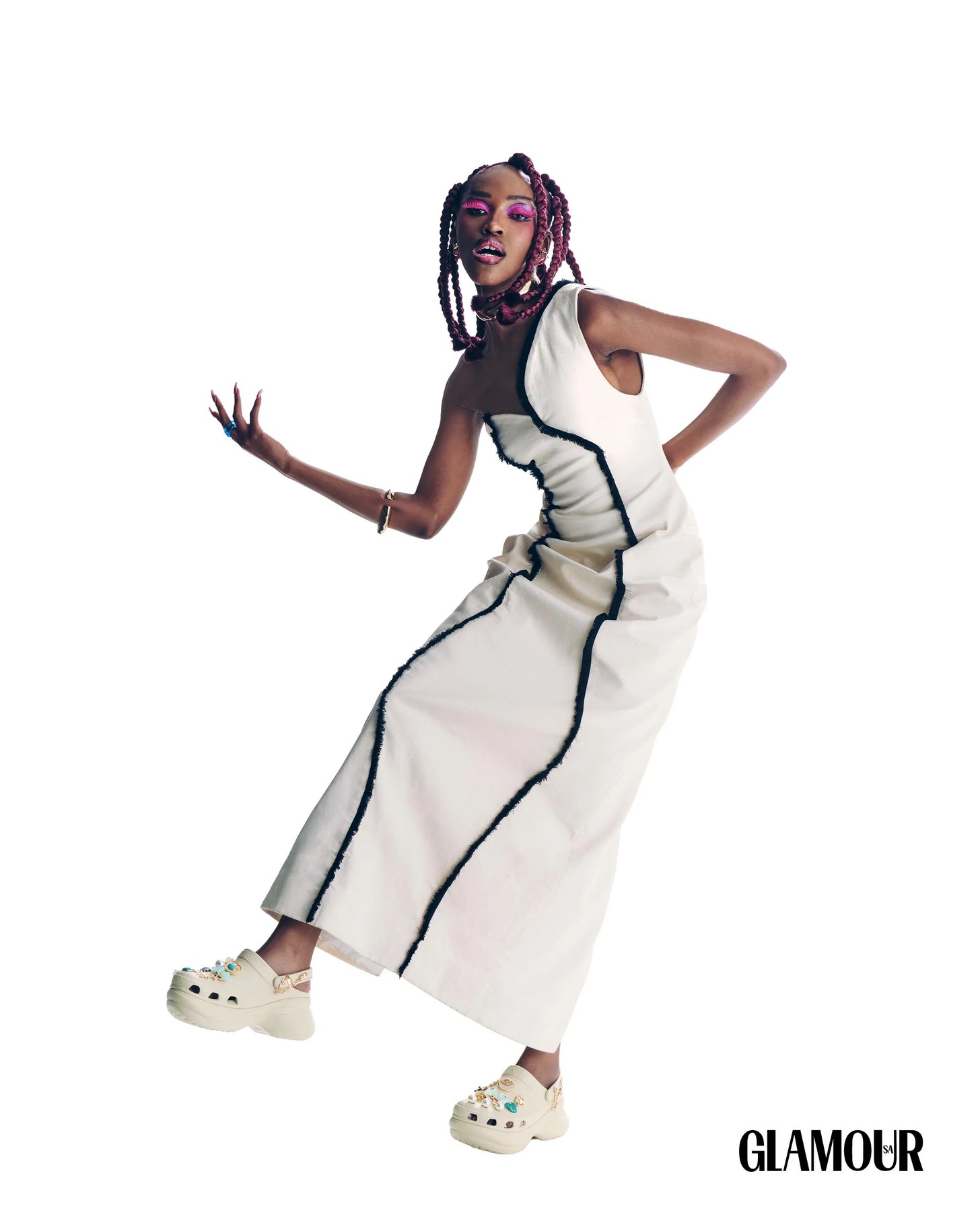
G: As a designer — thinking of your journey to becoming who you are and still having more to achieve — what are your thoughts on a world that wants to make things in two minutes?
ML: On social media, everyone wants to be told they’re special and become an influencer. But if everyone is special, no one is. There’s something extraordinary in being ordinary.With designers, for example, you have people who study design, pay someone else to do their patterns, and just design from there. But if you start from the bottom, teach yourself pattern-making and sewing, you understand more and you do better work. Titles lose their value in an industry built this way.There’s something to be said for working your way up. If people are going to know me, I’d rather they know me for my work first. I should come second to it.
G: Your work is extremely public.How do you deal with criticism?
ML: I’ve always tried to remain open to feedback, but you need to understand where it’s coming from and what’s behind it. Everyone always has an opinion, and some people criticise others on social media without understanding the intention behind what they’re seeing.That’s when it tips from constructive into destructive criticism.Constructive criticism, even when it’s hard to hear, opens space for growth.I don’t believe in criticising someone just to hurt them, especially if the person criticising is in pain and using it as a way to pass on that pain. When it reaches that point, I think a private conversation serves everyone far better.
G: What is your process when it comes to choosing fabrics and starting a collection ?
ML: Every collection starts with a life lesson or a psychological concept. How we land on fabric varies. Sometimes we come across something by chance in a store, or while sourcing for a client.Sometimes I buy a fabric purely becauseI love how it feels, and it sits with us fora season or two until the right moment comes. Often our fabrics come through specialist suppliers holding stock from the nineties, from a time when SouthAfrica still manufactured its own fabric instead of relying so heavily on imports.In Abundant Anthesis, for instance, we used a dark green protea-motif damask woven in the nineties. The collection’s message was about blooming as yourself, about valuing personal development over external accolades. I think we’ve become so focused on outside validation that it comes at our own expense.It all comes down to whether the fabric we choose strengthens the message of the collection.
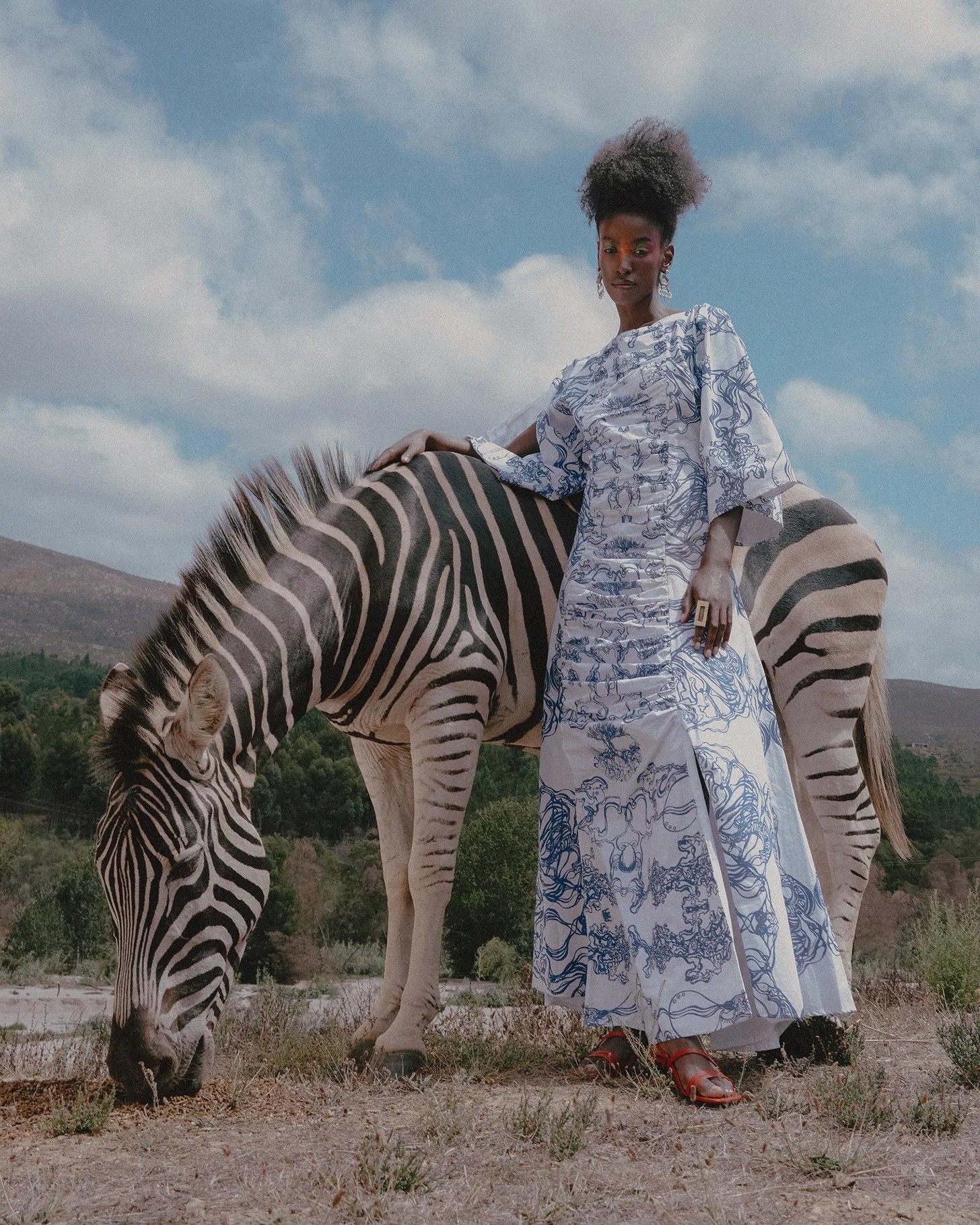
G: How do you come up with a theme?
ML: Every theme is rooted in a mental concept or a personal life experience.Our debut collection at SA Fashion Week for the New Talent Competition in 2021, Degendered Geometry, came out of my own exploration of gender back in school, built from a thesis I’d written on the subject. We used camouflage, typically read as masculine, reinterpreted in pink, setting femininity against masculinity, explored further through juxtaposed cuts and silhouettes.Another collection, Circular Criticism, was built on the idea that criticism runs both ways, inward and outward. We’re constantly criticising ourselves while being criticised by others. Using eco-ink roller prints, we created a red-and-cream image of a woman looking at her own reflection with a tree of life between them, symbolising self-reflection and growth from that experience.It all comes together through storytelling: what’s the theme, how do the fabrics amplify it, how do the colours interact, and does all of it strengthen the message?
G: How has working in the fashion landscape and seeing the slow demise of our manufacturing industry affected you?
ML: It’s given me a real sense of responsibility. Now that I’m embedded in the industry, I feel I need to help strengthen what’s left of it. That might mean finding retired seamstresses to teach others, or going into high schools to teach basic mending and pattern-making. In the business, I always try to work with local dye houses, printers, and artisans rather than outsourcing to overseas suppliers. Part of the reason why our price points sit where they do is that our seamstresses are paid above industry standard for their level of expertise. It’s common in this industry to underpay people to protect the bottom line, but that strips the value from the people actually making the garments. I wish more brands chose differently instead of sending units overseas because it’s faster and more profitable. As South Africans, we understand what it means to struggle and put in the work, and I think there’s value in carrying a bit more of that struggle if it means lifting up the people around us.
G: I want to talk about sustainability.What are your thoughts and how do you run your business?
ML: I try to be as sustainable as I reasonably can be. I believe in the values behind sustainability, but I don’t believe in using it purely as a selling point. If people ask how we work and the answer happens to be sustainability-oriented, that’s a good outcome, but I won’t lead with it if it’s not genuinely the ethos. We try to use natural fabrics wherever possible, paying attention to certifications and local production.We also rely heavily on dead stock and limited-availability fabric. We used to work with recycled fabrics, but moved away from them after research showed they can actually be worse for the environment than the original material, due to the chemical processing involved and increased microplastic release.For printing, we stick to roller prints with eco-inks, which are natural-based and don’t damage groundwater the way conventional printing does. I also use zero-waste pattern-cutting where I can.Offcuts are kept rather than thrown away, since six months later we might need a small piece for a pocket or a bag.It’s not a perfect system; around 15–20percent of what I use isn’t completely natural, and occasionally a synthetic is needed to achieve a particular effect in the design.
G: How are you profitable being as intentional as you are, while wanting to build community?
ML: Profit isn’t the end goal for me.I value people and community more than I value profit. A real conversation and connection with a client means more tome than squeezing the most out of a sale.The world has become so capitalistic and money-driven that people are treated as disposable tools rather than people.I place more weight on the well being of the people working with us, and on the customers buying from us, than on profitability. I know we could charge more, but there’s a point where that starts to exclude people, and I don’t want to reach a point where I no longer know who I’m creating for.I had a customer who saved for over six months to afford one of our pieces. She thought about that dress for half a year.That pushes me to constantly find ways to bolster our construction and garment finishes to last for many years to come.Every time she wears that piece, I want her to have a good day and make new memories in it. That emotional value matters far more to me than charging double the price.
G: What are your thoughts on the MetGala theme “Fashion is Art”? Do you believe fashion is art?
ML: It’s a question — is fashion art?I think fashion could be art, but I don’t think fashion is currently treated as art.With social media, it’s become about trends and being the “it girl”. Fashion is abused in a conformist kind of world.Fashion used to be a thing where you could express emotion, show your vision, and only you would own it. It’s become a thing of money, H&M and Zara popping out things every day. That, for me, is not art. Certain aspects of fashion still hold their status; what Jonathan Anderson does at Dior, and Daniel Roseberry atSchiaparelli, blows my mind. The way they interpret ideas and themes into garments that still hold the values of the brands they’re in, that for me is art. Even if you look at haute couture, it’s measured by more than creativity; it’s the artisans doing everything by hand behind the scenes. You could literally have a dress on display in your home as an art piece.But in the whole sea of fashion, there are very few designers for whom fashion is definitively art.
Recent stories by:
Tania Durand

The Gucci codes driving Demna’s new era

Wedaad Lima on fashion, motherhood and marketing G-Star Africa

LFW: H&M brings Nick Knight, Labrinth and Alex Consani to its A/W 2026 London show

LFW: ONALAJA unveils its new collection, Re:Birth

Simonsig opens Vonkel, a mediterranean-inspired restaurant in Stellenbosch
GLAMOUR Recommends
Mastering Spring layering: Your guide to transitional fashion
South African born Charlize Theron’s fashion Odyssey isn’t over yet!
Shopping Edit: Items on my radar to invest in now
Newlyweds Zendaya and Tom Holland dazzle with their couple style on the Spider-Man red carpet
Josh Goot and Christine Centenera: Redefining wardrobe essentials with H&M
Discover the Perfect Luggage for Your Travel Adventures
Fashion Director's edit: Eyewear for winter 2026: Embrace the bold revolution


